Our Story

Geinesis: The Spark That Redefined Energy

Others drill deeper for crumbs of power—outputs today's nanotech solar can beat without a single meter of casing. We went smarter. No hydrothermal reruns. No bloated closed loops. We rebuilt the materials stack, shattered heat-transfer bottlenecks, and drive more megawatts per well—turning drilling from a cost into an edge. This isn't incremental. It's a new class of geothermal.

Our Journey

From Founding to Market Leadership

2019

The Beginning in Korea

GEIOS Technologies was founded in Korea, marking the start of our journey to revolutionize geothermal energy through breakthrough subsurface engineering and nanotechnology.

2021

Nanogeios Lab & SPARC Innovation

Established Nanogeios Laboratory and began developing SPARC Nanofoam technology. Our proprietary nanomaterials started taking shape, designed to withstand extreme subsurface conditions.

2022

Testing & Simulations

Intensive laboratory testing and simulations validated our breakthrough technologies. SPARC Nanofoam achieved 12.7× thermal conductivity enhancement with zero seismicity—materials engineered to survive extreme conditions.

2024

The Fusion Insight

Geothermal became our proving ground for universal nanotech applications. The extreme conditions (heat, corrosion, pressure) unlocked modular solutions for every industry—from oil recovery to aerospace fuels.

2025

Market-Ready Technology

After extensive testing and lab validation, our technology is ready for market deployment. With $9M+ revenue generated through Nanogeios Laboratory, we've entirely self-financed our R&D—proving innovation can fund itself.
"While others still push 20th-century old-school drilling and technology, we innovate and architect nanoscale, advanced and high-energy capture, Nanofoam injection multiplies surface area and opens heat pathways; corrosion-immune interfaces survive 300 °C, 100 bar, and radiolytic attack. Due to our success, we today license our nanotech solutions to nuclear, oil & gas, and aerospace."

— Shad Abdelmoumen Serroune

CEO & Inventor

$9M+
Revenue Generated
13
Patents Filed
100%
Self-Financed R&D
215
Successful Lab Tests

Our Obsession

Nanogeios Laboratory doesn't follow trends—we forge them. We operate the world's harshest R&D environment—Earth's radiogenic core—to birth nanomaterials that outperform every incumbent solution.

Competitors optimize turbines. We optimize atoms.

Our revenue funds peer-reviewed discovery. Our patents power industries we haven't entered—yet.

Beyond Geothermal

High-Impact Industries for Derivation

GEIOS technology transcends geothermal—our breakthrough nanomaterials and systems unlock transformative applications across multiple industries.

Oil & Gas
Enhanced Recovery and Downhole Operations
01
Key GEIOS Components

NHN nitrogen-hybrid nanofoam for proppant-free stimulation; SPARC-aligned phonon corridors for thermal enhancement; nano-structured borophene/silicon-carbide casings.

Derivable Benefits

Deploy NHN at low stimulation pressures (e.g., ~2,500–3,000 PSI) to replace sand, keep fracture apertures and pore connectivity open longer, and increase fluid/gas throughput in tight shale and mature reservoirs. Tunable in-situ properties (viscosity/elasticity) match rock mechanics; closed-loop nanoparticle recovery supports compliance.

Impact

Higher, longer-lived productivity (more barrels/MCF per stage, steadier declines), lower water use, reduced sand logistics and screen-outs, lower seismic risk, and extended well life—directly tackling the bottlenecks of unconventional recovery.

Nuclear Energy
Advanced Reactors and Thermal Storage
02
Key GEIOS Components

NanoVault PCM heat exchangers; SPARC Nanofoam for conductivity; KAIGEN membranes for gas management.

Derivable Benefits

Deploy NanoVault for intermediate thermal buffering in Gen IV reactors (e.g., molten salt or gas-cooled), maintaining ±1°C stability and 94% retention over 7-hour cycles to mitigate load-following transients. Integrate SPARC for radiation-resistant heat transfer in fuel assemblies.

Impact

Enhances safety in high-temperature (600–900°C) environments; supports hybrid nuclear-geothermal systems for baseload stability.

Aerospace
Propulsion Fuels and Thermal Systems
03
Key GEIOS Components

Model D methalox production; NanoVault for cryogenic buffering; KAIGEN for >95% gas purity separation.

Derivable Benefits

Scale radiolysis-derived CH₄/H₂ for on-site methalox fuel synthesis; use NanoVault to store and release thermal energy during launch vehicle ground operations or turbine pre-heating.

Impact

Provides carbon-negative, high-purity propellants for reusable rockets, leveraging 30+ year material longevity.

Power Generation
Gas Turbines and Peaking Plants
04
Key GEIOS Components

NanoVault for thermal storage; SPARC phonon optimization; AI-GMS for predictive control.

Derivable Benefits

Integrate NanoVault as a high-density PCM buffer to store excess turbine heat, releasing it at 85% capacity during peak demand—stabilizing output in combined-cycle plants. SPARC enhances turbine blade coatings for >30 W/m·K conductivity under 1,000°C+ conditions.

Impact

Improves efficiency by 40% (via AI optimization parallels) and enables flexible grid integration without battery dependency.

Concentrated Solar Power
CSP and Industrial Heat Processes
05
Key GEIOS Components

NanoVault buffering; NHN for receiver tube stimulation; nanostructured materials for corrosion resistance.

Derivable Benefits

Apply NanoVault to molten salt storage for extended dispatchability; use NHN to create stable fracture networks in solar receiver substrates, boosting heat transfer in cyclic 800°C environments.

Impact

Reduces LCOE through superior thermal stability and zero-discharge operations.

GEIOS Mining
In-situ extraction + on-site geothermal
06
Key GEIOS Components

EQG geocasing with IHE; NHN stimulation; mineral-selective nanofluids; AI + sensor stack.

Derivable Benefits

One hub runs leaching and power; NHN creates stable micro-fractures while nanofluids bind Li/REE/U, boosting recovery and uptime.

Impact

Lower AISC and CO₂e; converts stranded deposits into bankable, self-powered assets.

ARCSTASIS Technology

Advanced Photon + Phonon Hybrid Solar Panel Architecture

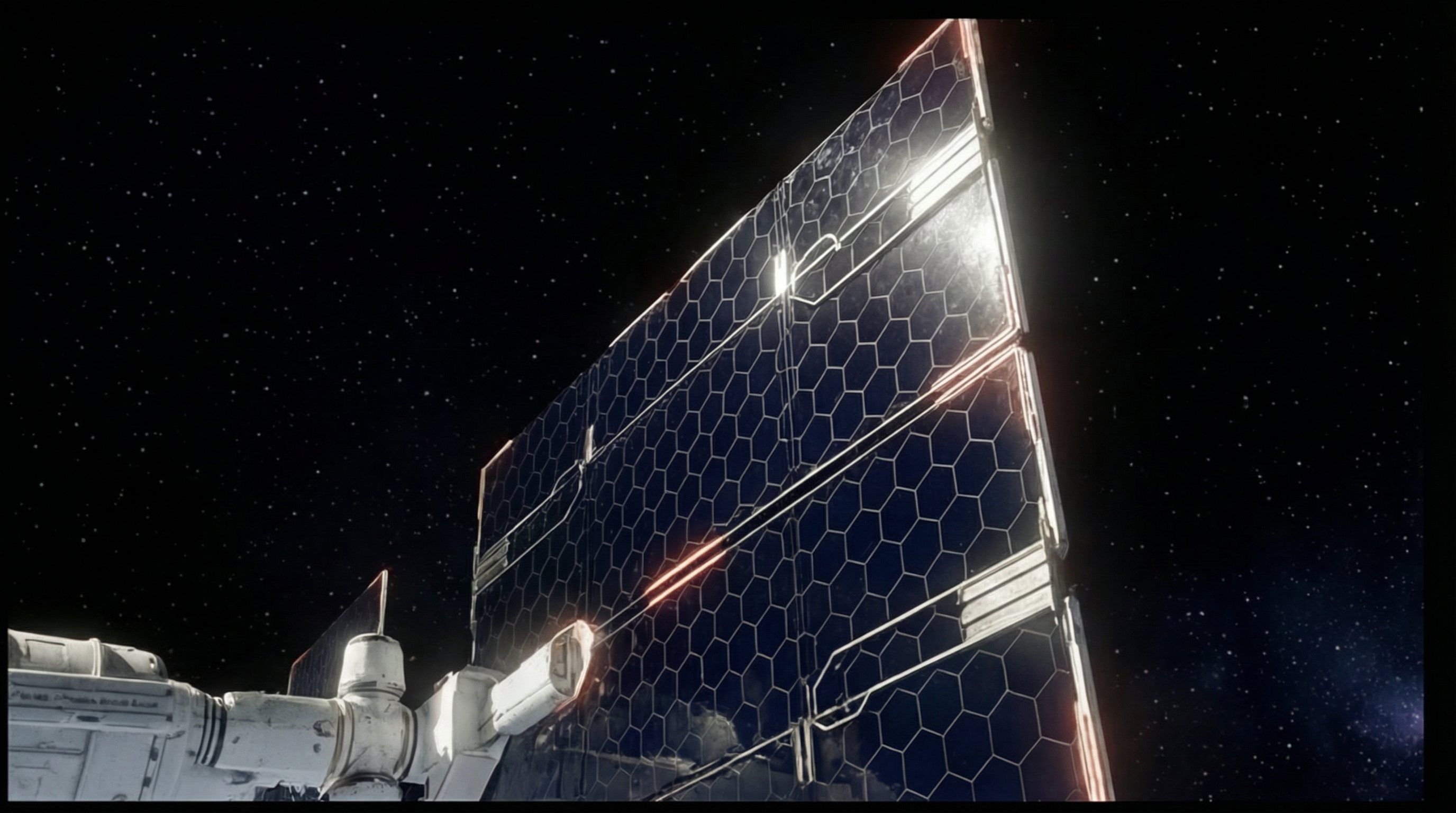
A space-grade solar array leveraging GEIOS EQG geothermal phonon-engineering—uniting photons and phonons for record efficiency and lower degradation.

Advanced Photon + Phonon Hybrid Solar Panel in space with hexagonal honeycomb structure
Sub-bandgap Absorbers

Panel edges feature quantum-engineered sub-bandgap absorbers that capture low-energy infrared photons normally lost in conventional PV. These nanostructured layers extend spectral response beyond 1100nm, recovering up to 8% additional energy from thermal radiation.

SPARC Corridors & Thermal Backplane

The hexagonal honeycomb structure integrates SPARC (Synchronized Phonon-Aligned Radiant Conduits) pathways throughout the panel interior. These nanoscale thermal highways channel waste heat through a multi-layer SiC/BN backplane.

70% Heat RecoveryQuantum Confinement±1.5°C Stability
Power Conversion System

The robotic arm houses the integrated Photon + Phonon power conversion unit. Captured thermal energy from SPARC corridors feeds directly into thermoelectric generators, while photovoltaic output merges through MPPT controllers for unified DC power delivery.

Photon: 22% eff.
Phonon: +15% boost
Hover over highlighted areas to explore AR components
Interactive AR
Space Technologies
Photon + Phonon Hybrid Solar Panel
07
Enhanced Power Generation and Thermal Management
Key GEIOS Components

Phonon-engineered SiC/BN backplane for waste-heat capture; Micro-NanoVault nanorods for quantum-confined heat routing; SPARC-aligned phonon corridors for low-scatter thermal transport.

Derivable Benefits

Deploy at zero added pressure (passive integration); Convert 70% PV waste heat into +15–25% extra electricity (lab-tested 166–336% thermal conductivity gain); Keep panel temperatures stable ±1.5°C over 4,000 cycles; 94% heat retention proven at 240°C → transposed to space vacuum. Tunable in-situ properties (conductivity/elasticity) match lattice mechanics; closed-loop phonon recovery supports radiation-hard compliance.

Impact

Higher, longer-lived power output (450–600 W/m² vs. 300 W/m² conventional); 20–40% smaller radiators, lower mass logistics, reduced thermal stress; Lower degradation (<0.0001%/cycle), extended panel life—directly tackling the bottlenecks of space PV efficiency.

Ready to Join the Next Chapter?

Our technology is market-ready after years of rigorous testing and validation. Partner with the team that turned Earth's core into a profitable, sustainable energy platform.

License Nanotech